Tongue Scraping: Ayurveda's Simplest Hygiene Habit
Thirty seconds every morning, a tool under $10, and an immediate effect on your breath: the tongue scraper is probably the easiest Ayurvedic ritual to adopt — and one of the few endorsed by dentists.
In this article 8 sections
- What are the benefits of tongue scraping?
- How to use a tongue scraper, step by step
- Copper, stainless steel or plastic: which tongue scraper to choose?
- What does your tongue coating say, according to Ayurveda?
- Tongue scraping every day: any precautions?
- How often should you scrape your tongue?
- What to expect after a few weeks
- Your questions
The tongue scraper (jihwa prakshalana) is a small curved instrument, made of copper or stainless steel, that you draw across the tongue every morning to remove the whitish coating that builds up overnight. Its best-established benefits: fresher breath — a large share of the sulfur compounds responsible for bad breath forms on the back of the tongue —, a sharper sense of taste and a visibly cleaner mouth. Small dental studies show it removes tongue coating more effectively than brushing the tongue with a toothbrush.
For Ayurveda, this gesture belongs to the dinacharya, the morning routine: the tongue coating is seen as a deposit of ama — the residues of incomplete digestion — better removed than swallowed with your first coffee.
What are the benefits of tongue scraping?
- Breath: this is the best-documented benefit. The back of the tongue hosts the bacteria that produce volatile sulfur compounds; scraping them off in the morning noticeably reduces morning breath.
- Taste: a tongue cleared of its coating perceives flavors better. Many practitioners report, after a few days, less pronounced cravings for sugar or salt — a plausible effect, not a proven one.
- Overall oral hygiene: the tongue is a bacterial reservoir the toothbrush reaches poorly; scraping complements brushing and flossing without replacing them.
- The Ayurvedic reading: tradition sees it as a way to gently stimulate the digestive organs (the tongue is considered their map) and to awaken agni, the digestive fire, before breakfast. That is a traditional interpretive framework, not a demonstrated fact.
How to use a tongue scraper, step by step
- In the morning, on an empty stomach, before drinking or eating — ideally before brushing your teeth.
- Stick out your tongue and place the rounded edge of the scraper as far back as possible without triggering the gag reflex.
- Draw it forward in one gentle, continuous stroke, from back to tip. No heavy pressure: the coating comes off easily.
- Rinse the instrument, repeat 5 to 7 times, covering the whole surface, edges included.
- Rinse your mouth with water, wash the scraper with soap, dry it.
Total time: 30 seconds. If the gag reflex bothers you, start at the middle of the tongue and work backward gradually over the days — it fades quickly. The classic beginner mistake: pressing too hard or multiplying strokes until the tongue feels raw. The coating comes off effortlessly; whatever remains after seven gentle strokes does not need to go. Scraping flows naturally into oil pulling for those who practice the oil mouth rinse.
Copper, stainless steel or plastic: which tongue scraper to choose?
| Material | Advantages | Limitations | Typical price |
|---|---|---|---|
| Copper | The traditional choice; the metal’s antibacterial properties; durable | Oxidizes (a normal patina), needs regular cleaning | $5–12 |
| Stainless steel | Unalterable, hygienic, maintenance-free | None, apart from lacking the traditional “endorsement” | $4–10 |
| Plastic | Gentle, fine for trying it out | Less effective, wears out fast, avoidable waste | $2–5 |
Copper has tradition’s favor, stainless steel that of simplicity — both do the job very well. Our detailed comparison of copper, steel and plastic scrapers reviews the upkeep and lifespan of each option. A good tongue scraper lasts for years: it is probably the best benefit-to-price purchase in the whole Ayurvedic toolkit.
What does your tongue coating say, according to Ayurveda?
Before scraping, observe: tradition treats the tongue as a mirror of digestion. A thick white coating would suggest excess Kapha or abundant ama (a meal too heavy or too late the night before); a yellowish coating, Pitta heat; a dry, cracked tongue, a Vata imbalance. This reading has no medical diagnostic value — a coating that changes abruptly, pain or persistent patches belong with a dentist or doctor — but it turns those 30 seconds into a small daily appointment of self-observation.
Tongue scraping every day: any precautions?
The practice is very safe, on a few conditions:
- Gentleness: scraping hard does not remove more coating, but it can irritate the taste buds. If the tongue becomes sensitive, skip a day or two.
- Sores and lesions: canker sores, a painful fissured tongue, oral thrush — pause and let things heal; see a professional if a lesion persists beyond two weeks.
- Instrument hygiene: wash with soap after each use, never share it, replace it if the edge becomes rough.
- Not a treatment: persistent bad breath despite good hygiene can signal a dental, ENT or digestive problem — raise it with a professional rather than scraping harder.
The site’s general rules of caution are gathered in our safety and precautions guide.
How often should you scrape your tongue?
Once a day, on waking, before drinking or eating, is the traditional rhythm of dinacharya and is enough for most people. The coating rebuilds overnight, so the gesture is worth repeating each morning rather than spacing it out over several days.
| Frequency | For whom | Note |
|---|---|---|
| Once a day, in the morning | The vast majority of people | Traditional rhythm, enough for breath and taste |
| Twice a day (morning and evening) | Marked bad breath, smokers, a heavily coated tongue | Gentle pressure, to avoid irritating the taste buds |
| After every meal | Not recommended | No added benefit, risk of irritation |
A small crossover study by Quirynen and colleagues, published in 2004 in the Journal of Clinical Periodontology, had 16 volunteers without gum disease clean their tongue twice a day for two weeks with a plastic scraper or a toothbrush. Tongue coating decreased significantly with both tools and taste sensation improved, especially with the scraper, while the reduction in bacterial counts on the tongue was negligible (see the study). In other words, scraping removes the coating that feeds odor-producing bacteria more than it "sterilizes" the tongue, so scraping harder or more often adds nothing. A tongue that stays thickly coated despite daily scraping is better read as a digestive signal (see agni, the digestive fire) than as a reason to scrape more.
What to expect after a few weeks
The effects on breath and taste are immediate — from the very first morning. What changes with consistency is the habit of observation: the coating becomes daily feedback on how you ate and slept. Many people find that a late or overly rich dinner shows up on the tongue the next day — a simple feedback loop that, better than any lecture, nudges you toward lighter evenings. That is exactly the spirit of dinacharya: small gestures that make you attentive, day after day.
Your questions about tongue scraping
Is tongue scraping really effective against bad breath?
Yes, it is its best-demonstrated benefit: most of the sulfur compounds responsible for morning breath form on the back of the tongue, and scraping removes them better than a toothbrush. Bad breath that persists throughout the day, however, deserves a dental or medical opinion.
Should you scrape your tongue before or after brushing your teeth?
Ayurveda puts it first thing, on an empty stomach, before even drinking: the idea is to remove the overnight coating rather than swallow it. In practice, before brushing is the most logical order; what matters most is daily consistency, whichever order you choose.
Can you scrape your tongue with a spoon?
Yes, the edge of an upturned teaspoon makes a decent makeshift scraper and lets you try the gesture before buying anything. A proper U-shaped tongue scraper remains more effective and more comfortable: its shape hugs the tongue and covers the full width in one stroke.
Why is my tongue white in the morning?
A thin white coating on waking is normal: dead cells, bacteria and debris accumulate overnight, when saliva flow drops. Ayurveda reads it as a deposit of ama linked to digestion. A very thick coating, a painful one, or one that persists despite good hygiene warrants a consultation (thrush or another cause).
How often should you use a tongue scraper?
Once a day, in the morning on an empty stomach, is enough — it is the traditional rhythm and the one used in oral-hygiene studies. There is no point repeating it through the day: gentleness and consistency matter more than intensity, and an over-scraped tongue can get irritated.
Can you scrape your tongue twice a day?
Yes, if you have marked bad breath or smoke, a second gentle pass in the evening is reasonable. More than twice a day brings no added benefit and can irritate the tongue.
Can you scrape your tongue too much?
Yes. Scraping too often or too hard can make the tongue red, sensitive or slightly sore. Reduce the pressure first; once a day with a light motion is enough for most people.
Our picks
Accessories chosen to go with this guide — prices in euros, VAT included, delivery in 8 to 15 business days, free from €39. Browse the whole shop.
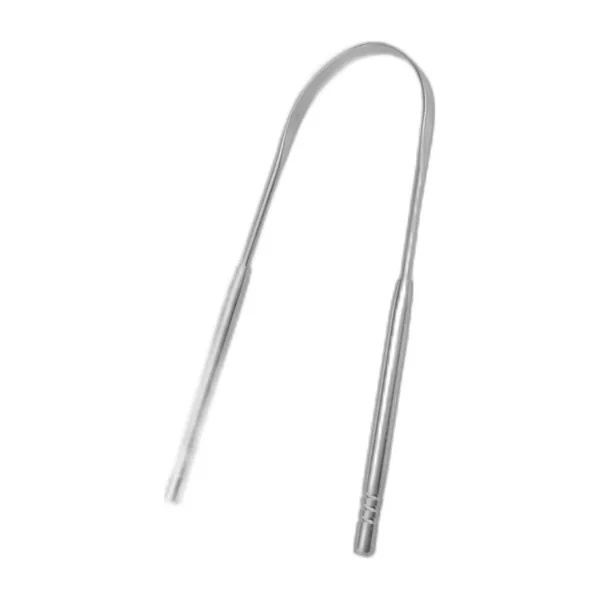 U-shaped tongue scraper, 304 stainless steel (set of 2)
Two U-shaped 304 stainless steel tongue scrapers for the first thirty seconds of your morning, before the first glass of water. Nothing to maintain.
U-shaped tongue scraper, 304 stainless steel (set of 2)
Two U-shaped 304 stainless steel tongue scrapers for the first thirty seconds of your morning, before the first glass of water. Nothing to maintain.
Free newsletter
One practical Ayurveda tip every Sunday
A seasonal habit, a recipe or a ritual taken from our articles, in a two-minute read. Your welcome gift: the 7-step Ayurvedic morning routine, unlocked right away. One-click unsubscribe.