Incense and Home Fragrance in Ayurveda: Sandalwood, Vetiver, Camphor
The sandalwood of temples, the vetiver of summer, the camphor of rituals: incense has always been part of Ayurveda. But you still have to tell natural incense from a stick dipped in synthetic perfume — and talk honestly about smoke.
In this article 8 sections
- What place does incense hold in Ayurveda?
- Sandalwood, vetiver, camphor: which scents for which use?
- How do you tell natural incense from synthetic incense?
- Is incense smoke dangerous? Let's talk about it honestly
- Which smoke-free alternatives fit an Ayurvedic home?
- Using incense well: ritual rather than habit
- How long it takes and how long to use it
- Your questions
Natural incense is incense made solely of plant matter — resins, woods, roots, ground herbs, bound with a gum — with no synthetic perfume and no chemical dipping bath. It is the minority of the market: most cheap sticks are bamboo cores coated in inert powder, then dipped in synthetic fragrances. Telling the difference changes everything: the scent, the use… and the quality of the air you breathe.
Here are the classic scents of the Indian tradition, the criteria of a good incense, and the common-sense rules about smoke — the subject sellers prefer to avoid.
What place does incense hold in Ayurveda?
Fumigation (dhupana) has accompanied Indian rituals for millennia: purifying a space, marking a moment, supporting meditation. Ayurveda adds its dosha reading: warm, sweet scents ground Vata, fresh ones soothe Pitta, camphorous and spicy ones stimulate Kapha. Incense belongs to well-being and ritual, not treatment: it creates a frame — the olfactory signal that tells the brain "we are switching gears" — and that is already a lot. It fits naturally into a meditation practice or an evening routine, provided you ventilate (more on that below).
Sandalwood, vetiver, camphor: which scents for which use?
| Scent | Profile | Dosha effect (tradition) | Typical use |
|---|---|---|---|
| Sandalwood | Creamy, soft woody | Soothes Pitta and Vata | Meditation, evenings, ritual |
| Vetiver | Earthy, fresh root | Cools Pitta | Hot summers, grounding |
| Camphor | Sharp, penetrating | Stimulates Kapha | Ritual purification, burned briefly |
| Nag champa | Powdery floral (frangipani, halmaddi) | Balancing | The ashram classic |
| Frankincense | Citrusy resin | Clarifying | Meditation, contemplation |
| Rose, jasmine | Sweet florals | Soothe Pitta, the heart | Relaxation, bedroom (ventilated) |
Two points of honesty. True sandalwood (santalum album) is rare, protected and expensive: a $2–3 box of sticks contains none — see our sandalwood profile on this ecological issue. Ritual camphor is used in tiny amounts, burned briefly: its smoke is irritating. As for vetiver, its root is also used in scented water and hand fans — typically Ayurvedic smoke-free alternatives.
How do you tell natural incense from synthetic incense?
- A declared composition: a serious maker lists resins, woods, herbs and binder. "Perfume", "fragrance" or no ingredient list at all = probable synthetic dipping.
- The method: "hand-rolled" or "masala" (a rolled herb paste, the Indian tradition), or Japanese bamboo-free incense, signal the top of the market.
- The cold scent: natural incense smells of raw material (wood, resin, hay); dipped incense smells of heady, almost cosmetic perfume.
- The burn: moderate smoke and a scent that stays round; chemical incense stings the nose and saturates the room.
- The price: expect $5 to $12 for a box of 10 to 20 natural sticks, more for Japanese incense or sticks rich in noble resins. The $2 mega-boxes physically cannot contain quality raw materials.
Is incense smoke dangerous? Let's talk about it honestly
This is the real subject, and it would be dishonest to dodge it: all combustion releases fine particles and volatile compounds, natural incense included. Studies have measured significant particle levels when incense burns in poorly ventilated indoor spaces. The risk-reduction rules:
- Ventilate during and after: a cracked-open window is non-negotiable.
- Dose: half a stick is often enough; incense marks a moment, it does not need to burn all day long.
- Avoid it in children's bedrooms, around people with asthma or respiratory conditions, and during pregnancy as a precaution.
- Choose natural: it does not remove combustion particles, but it avoids adding synthetic compounds on top.
Neither panic nor denial: an occasional stick in a ventilated room is nothing like heavy daily use in a closed space. Our safety guide repeats the general principle: natural does not mean harmless.
What long-term data exist concern heavy, chronic exposure. In a prospective cohort of 61,320 Singapore Chinese adults, where daily home incense burning is common, long-term use was associated with a higher risk of squamous cell carcinomas of the respiratory tract, especially of the upper airways, with no overall effect found on lung cancer (Friborg et al., 2008, Cancer). That is decades of intensive home use, far from a few minutes of burning in a ventilated room, but it confirms that incense smoke is not neutral for the airways. Day to day, the effects people actually notice are short-lived:
| Reported effect | Most likely cause | What to do |
|---|---|---|
| Headache after a long session | Poorly ventilated room, burning for hours | Air the room, shorten sessions |
| Throat irritation, mild cough | Inhaled particles and volatile compounds | Burn less, open a window |
| Stinging or watery eyes | Too much smoke in a small space | Half a stick, or none in small rooms |
| Skin reaction when handling raw resin | Rare sensitization to boswellia-family resin | Handle olibanum with tongs |
The skin point is rare: a confirmed allergic contact dermatitis has been reported after repeated application of a cream containing Boswellia serrata extract, the tree family of olibanum (Acebo et al., 2004, Contact Dermatitis); it concerned a cream, not burned resin, but it is a good reason to use tongs if you handle resin often. During pregnancy, no study has measured a risk specific to incense: the caution follows the general rule of limiting indoor combustion particles, so keep it occasional, ventilated and out of the bedroom, or switch to the smoke-free options below. Coughing, breathing discomfort or recurring headaches after use mean stopping, and seeing a doctor if they persist.
Which smoke-free alternatives fit an Ayurvedic home?
- Vetiver or rose water as a mist: scented freshness without combustion, very "Pitta-friendly" in summer.
- An essential-oil diffuser (cold diffusion, nebulizing or ultrasonic): no combustion, but essential oils carry their own precautions — pregnant women, children, pets, asthma: read up first.
- Fragrant roots and woods: a bundle of vetiver roots in the closet, a piece of sandalwood in a drawer — slow scent, nothing burned.
- Fresh flowers: the sattvic solution par excellence, timeless in Indian homes.
Using incense well: ritual rather than habit
Incense gives its best in occasional, intentional use: half a stick at the start of a meditation or pranayama session, a frankincense resin on charcoal to mark a special moment, a discreet sandalwood in the evening before bed. On the equipment side, a simple wooden or brass incense holder at $4 to $10 is enough; for resins, plan on a clay burner and charcoal discs, handled with tongs. Place the burner on a stable, fireproof surface, away from curtains and out of reach of children and pets, and never leave it burning unattended. Ayurveda is a matter of measure: it is precisely because it stays occasional that incense keeps its evocative power.
How long it takes and how long to use it
Our article natural incense: how to spot the real from the fake and the smoke section above cover quality, user feedback and the question of combustion. One practical question remains: how long does it take to feel an effect — and how long can you safely let a stick burn? The two answers have nothing to do with each other, and that's exactly what causes confusion.
The felt calm: near-instant, but not pharmacological
This is the most widely misunderstood point: the calming effect reported within the first few minutes of a sandalwood or vetiver stick doesn't come from a slow-building chemical action, as with an herb taken as a course. It relies on an olfactory-association mechanism — with repetition, the scent becomes a signal the brain links to a moment of calm (meditation, an evening ritual). This signal kicks in as soon as the scent is perceived, within a few dozen seconds, which explains why so many users describe an "immediate" sense of calm in our article ayurvedic incense reviews. The more the ritual is repeated, the stronger the association becomes — something like an olfactory version of Proust's madeleine, not an active compound that needs to reach a blood concentration.
How long before the ritual really "sets in"?
| What's being sought | Realistic timeline | Why |
|---|---|---|
| A sense of calm in the moment | A few minutes, from the very first use | Olfactory signal plus a ritual gesture that marks a transition |
| Automatic scent-to-relaxation association | Several weeks of repeated practice | Gradual conditioning, as with any habit tied to a context |
| A "therapeutic effect" on anxiety or sleep | Not documented | No clinical trial validates a pharmacological effect specific to incense smoke on these conditions |
In other words: incense can help from the very first session, but its full ritual potential — that almost Pavlovian shift it helps trigger — builds with repetition, over several weeks, rather than in a single isolated session.
The other sense of time: duration of smoke exposure
The smoke section above details this point: a prospective cohort study by Friborg and colleagues, published in 2008 in the journal Cancer, followed more than 61,000 people as part of the Singapore Chinese Health Study and observed an association between daily, heavy use over decades and an increased risk of certain upper-respiratory-tract cancers. That finding concerns cumulative exposure over years, very different from an occasional half-stick burned for a few minutes in a ventilated room: it's the cumulative duration of exposure, not the length of a single session, that makes the difference.
How long should a stick be left burning in practice?
- 5 to 15 minutes is usually enough to set a mood or accompany the start of a meditation session: a half-stick rather than a whole one;
- Avoid continuous burning for several hours in a closed room, whatever incense is used;
- Ventilate during and after: a slightly open window sharply cuts the buildup of particle concentration over time.
What to remember about these two timescales
The calming effect plays out in minutes, the ritual builds over weeks, and the documented health risk plays out over years of intensive cumulative exposure. Confusing these three timescales leads either to unrealistic expectations ("it doesn't work the first time") or to misplaced worry ("an occasional stick is as risky as daily use for twenty years"). Neither is founded.
Precautions
Whatever timeline you're after, the same precautions apply: always ventilate, limit frequency, avoid children's bedrooms and the presence of people with asthma during burning, and stay cautious as a precaution during pregnancy. For the full set of guidance, see our safety and precautions guide.
Your questions about incense and home fragrance in ayurveda
How can you tell if an incense is natural?
Check three things: a declared composition (resins, woods, herbs — no anonymous "fragrance"), masala-style or hand-rolled making, and a cold scent of plant matter rather than heady perfume. Price is a reliable clue: natural incense rarely costs less than $5 a box.
Is incense smoke bad for your health?
All combustion releases fine particles, natural incense included. The risk depends on dose and ventilation: an occasional stick with a window cracked open is nothing like heavy use in a closed room. Avoid incense around children, people with asthma, and during pregnancy, as a precaution.
Which incense is best for meditation?
The classics are sandalwood (woody, calming), frankincense (clear resin, contemplation) and nag champa (the scent of ashrams). Light half a stick a few minutes before sitting down: the olfactory signal helps the brain switch over. Choose natural incense and air out the room after the session.
Why is real sandalwood incense so expensive?
White sandalwood (santalum album) is an overharvested, protected, slow-growing tree: its wood commands very high prices. Cheap boxes use synthetic perfumes or other woods. Incense containing real sandalwood costs real money — or is openly a reconstructed "sandalwood note", but then it is no longer natural.
Can you burn incense every day?
Not advisable in a closed room: daily smoke degrades indoor air quality. If incense is part of your ritual, keep it to half a stick, ventilate during and after, and alternate with combustion-free options: rose or vetiver water mists, fragrant woods, fresh flowers.
What is the difference between Indian and Japanese incense?
Indian masala incense is a paste of herbs and resins rolled around a bamboo core: rich scents, generous smoke. Japanese incense is extruded without a bamboo core: cleaner burn, subtler scents, higher price. For frequent indoor use, Japanese incense is often the better choice.
How long does it take to feel a calming effect from incense?
The felt effect can be near-instant, from the very first session, because it mainly relies on an olfactory signal linked to calm rather than a slow-acting chemical process. The full ritual effect, however, builds over several weeks of repeated practice.
How long can an incense stick be left burning?
5 to 15 minutes is usually enough, with a half-stick rather than a whole one in a small room. Avoid continuous burning for several hours, especially in a poorly ventilated space.
Does the health risk depend on the length of a single session?
No, it mainly depends on cumulative exposure over months or years. A 2008 cohort study found a risk linked to heavy daily use over decades, very different from occasional use of a few minutes.
Why does incense seem to work faster over time?
Because the association between the scent and the moment of calm strengthens with repetition, a mechanism close to conditioning. The more regularly the ritual is practiced, the more the scent alone is enough to trigger relaxation.
Why does incense give me a headache or a sore throat?
Usually because smoke has built up in a poorly ventilated room during a long session. Particles and volatile compounds irritate the eyes and throat and can trigger headaches in sensitive people. Opening a window, burning half a stick and keeping sessions short generally prevents it.
Can you burn incense during pregnancy?
No study has measured a risk specific to incense in pregnancy, so it is not formally contraindicated. As with any indoor combustion, keep it occasional, in a well-ventilated room and never in the bedroom; smoke-free options such as a hydrosol mist are the simplest choice.
Our picks
Accessories chosen to go with this guide — prices in euros, VAT included, delivery in 8 to 15 business days, free from €39. Browse the whole shop.
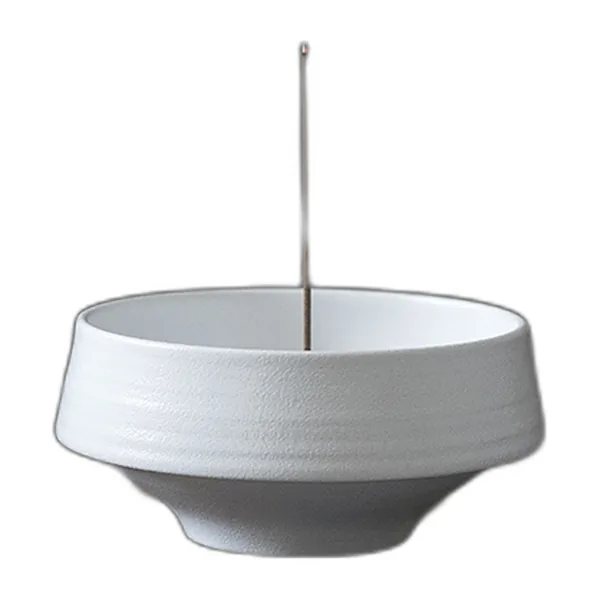 Ceramic incense holder cup, 13 cm
A handmade 13 cm ceramic bowl with a matte glaze: the incense stick stands upright in sand and the ash falls into the bowl, not onto the table.
Ceramic incense holder cup, 13 cm
A handmade 13 cm ceramic bowl with a matte glaze: the incense stick stands upright in sand and the ash falls into the bowl, not onto the table.
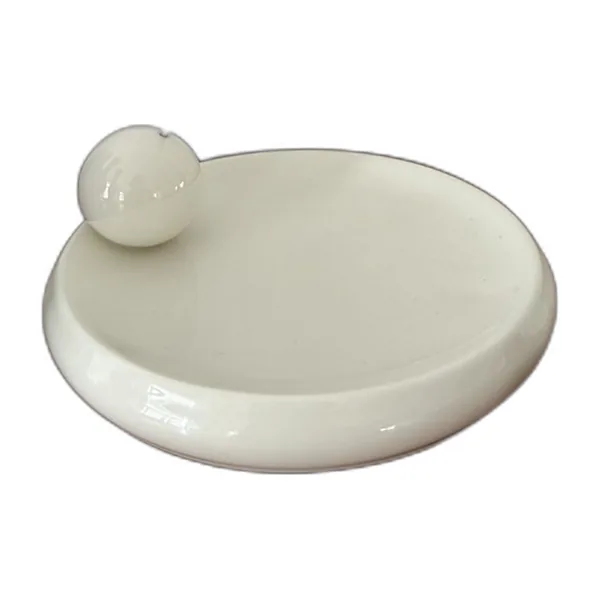 Ceramic incense holder, 13.5 cm dish with ball
A 13.5 cm ceramic dish with a drilled ball that holds the stick at an angle: the ash lands in the dish, not on the table.
Ceramic incense holder, 13.5 cm dish with ball
A 13.5 cm ceramic dish with a drilled ball that holds the stick at an angle: the ash lands in the dish, not on the table.
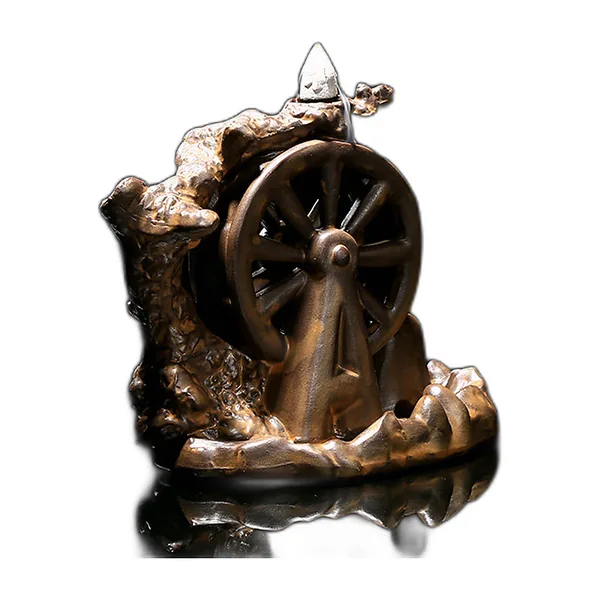 Ceramic backflow incense burner, water wheel
A ceramic backflow incense burner shaped like a water wheel: the cone smoke slides over the wheel and pours down like a waterfall.
Ceramic backflow incense burner, water wheel
A ceramic backflow incense burner shaped like a water wheel: the cone smoke slides over the wheel and pours down like a waterfall.
Free newsletter
One practical Ayurveda tip every Sunday
A seasonal habit, a recipe or a ritual taken from our articles, in a two-minute read. Your welcome gift: the 7-step Ayurvedic morning routine, unlocked right away. One-click unsubscribe.