Meditation and Ayurveda: Which Practice for Your Dosha?
You "tried meditation" and gave up? Ayurveda has a simple explanation: the technique probably did not match your temperament. A restless Vata, a perfectionist Pitta and a drowsy Kapha do not meditate the same way.
In this article 9 sections
- What does Ayurveda say about meditation?
- Which meditation for a Vata profile?
- Which meditation for a Pitta profile?
- Which meditation for a Kapha profile?
- Which technique to choose: the summary table
- How to start concretely (and stick with it)
- How long and how often should you meditate?
- Precautions: is meditation right for everyone?
- Your questions
In Ayurveda, meditation is not a single technique but a practice to adapt to your dominant dosha: quick, scattered Vata minds do better with sessions that are short, guided and anchored in the body; driven, demanding Pittas need a framework of letting go with no performance goal; Kaphas, steady but prone to drowsiness, benefit from dynamic practices — walking, chanted mantra, stimulating breathwork. The principle: you do not fight your temperament, you choose the doorway that suits it.
This approach solves the number-one problem for beginners: quitting. Most people who "can't meditate" simply followed a standard instruction (seated, motionless, twenty minutes, in silence) that suits some profiles and discourages the rest.
What does Ayurveda say about meditation?
Ayurveda and yoga, sister disciplines, treat meditation as care for the mind (manas) in its own right: it cultivates sattva — the quality of clarity and balance — against agitation (rajas) and inertia (tamas). Traditionally it is practiced in the morning, during the quiet window before dawn, woven into the dinacharya, the morning routine. On the modern research side: meditation, across all schools, is one of the most studied mental-wellbeing practices; the data suggest modest but real effects on perceived stress and attention, with large individual variation — which, at bottom, matches the Ayurvedic intuition: the right practice is the one that fits you.
Which meditation for a Vata profile?
The Vata mind is fast, creative, unpredictable — and silent stillness leaves it alone with a torrent of thoughts, which distresses more than it soothes. What works:
- Short and frequent: 5 to 10 minutes a day beats 30 minutes on Sunday.
- Guided: a voice to follow (an app, a recording) gives the mind a handrail.
- Anchored in the body: body scans, attention to points of contact, to sensations of warmth — anything that leads back to the concrete.
- A warm, stable environment: a blanket over the shoulders, same time, same place; the routine is itself an anti-Vata remedy.
A foot massage or a few slow breaths before sitting down help this profile a great deal — see our pranayama protocols, with alternate-nostril breathing (nadi shodhana) classically cited for balancing Vata.
Which meditation for a Pitta profile?
Pitta's trap: turning meditation into a performance — tracking progress, getting annoyed at "meditating badly," aiming for a state to achieve. What works:
- No goal at all: pure observation practices (passing thoughts, ambient sounds), where there is literally nothing to succeed at.
- Coolness: meditating in a cool room, by the water, under a tree; visualizations of the moon, water or greenery are traditionally indicated.
- Kindness: loving-kindness (metta) meditations soften self-criticism and irritability, Pitta's two classic excesses.
- Evenings too: a few minutes after work defuse the heat built up over the day.
If the critical mind stays overwhelming despite practice, that is not a meditation failure: intense stress or lasting irritability deserve to be explored with a professional — our article on stress and anxiety spells out those limits.
Which meditation for a Kapha profile?
Kapha sits down willingly... and falls asleep. Its challenge is not agitation but torpor. What works:
- Meditate early and sit up straight, never lying down, never after a meal; the 6 to 7 am window, before Kapha's morning heaviness settles in, is ideal.
- Active practices: walking meditation, mantra repeated aloud or chanted, standing meditation.
- Some stimulation first: a few minutes of movement or an energizing breath before sitting changes everything.
- Variety: rotating techniques avoids the comfortable rut where Kapha goes numb.
Which technique to choose: the summary table
| Dosha | Typical pitfall | Favorable practices | Suggested format |
|---|---|---|---|
| Vata | Scattering, anxiety in silence | Guided meditation, body scan, alternate-nostril breathing | 5–10 min, every day, same time |
| Pitta | Performance, self-criticism | Goal-free observation, metta, cooling visualizations | 10–20 min, cool setting, no progress tracking |
| Kapha | Drowsiness, inertia | Walking meditation, chanted mantra, trataka | 10–20 min, early morning, sitting tall or standing |
Trataka — steady gazing at a candle flame — is an excellent all-around practice: engaging enough for Vata, sober enough for Pitta, wakeful enough for Kapha.
How to start concretely (and stick with it)
- Identify your dominant tendency — the dosha test gives a first orientation.
- Choose ONE practice from the matching column and keep it for four weeks before judging.
- Start at 5 minutes, even for enduring profiles: consistency builds the habit, and length will come on its own.
- Attach the session to an existing habit: after tongue scraping and your morning wash, before breakfast.
- Write one line a day (done/not done, state of mind): it is the best predictor of sticking with it long term.
How long and how often should you meditate?
Tradition places meditation in the dinacharya, ideally in the morning on an empty stomach, and stresses daily regularity rather than a fixed length imposed from day one: a short practice every day beats an occasional long session.
| Profile | Frequency | Indicative duration |
|---|---|---|
| Beginner | Daily, even if short | 5 to 10 minutes |
| Established practice | Daily | 10 to 20 minutes |
| Occasional longer session | Weekend, high-stress period | 20 to 30 minutes |
A randomized controlled online trial by Fincham, Mavor and Dritschel, published in 2023 in Mindfulness (doi:10.1007/s12671-023-02119-2), assigned healthy adults to about 10 or about 30 minutes a day of seated or movement meditation for two weeks; among the 161 who completed it, well-being and mindfulness rose and distress fell in all four groups, with no significant difference between short and long sessions. Two weeks and a modest sample do not prove that longer practice never adds anything over time, but they support starting short and daily rather than waiting for long free stretches.
Precautions: is meditation right for everyone?
Meditation is broadly safe, but it is not trivial for everyone. In some people — a history of trauma, severe anxiety disorder, depression, psychiatric conditions — silent introspection can stir up difficult material; unpleasant effects (anxiety, derealization) are documented, rare but real. In those situations, practice with support (an experienced instructor, a therapist) rather than alone with an app, and talk to your doctor or therapist. Meditation never replaces treatment or psychotherapy: for established depression or anxiety, the professional comes first, the practice as a complement. Our general guidelines are in the safety guide.
Your questions about meditation and ayurveda
What is the difference between Ayurvedic meditation and regular meditation?
There is no separate "Ayurvedic" technique: what Ayurveda mainly contributes is a personalization grid. It recommends adapting the practice to your temperament — short, guided sessions for Vata, goal-free letting go for Pitta, dynamic practices for Kapha — and meditating in the morning, woven into the daily routine.
How long should you meditate each day according to Ayurveda?
Consistency beats duration: 5 to 10 minutes daily, at a fixed time in the morning, is worth more than a long occasional session. Vata profiles gain from staying short (5-10 min); Pitta and Kapha can aim for 10 to 20 minutes once the habit is in place. Increase only when the current length has become easy.
Why do I fall asleep while meditating?
It is the classic sign of a practice too passive for your current state — typical of Kapha profiles or of sleep debt. Meditate earlier in the day, never after a meal or lying down, straighten your posture, keep the eyes slightly open, or switch to an active practice: walking meditation, chanted mantra, trataka.
Can you meditate when you are very anxious?
Yes, but through the right doorway: for an anxious person (often a Vata excess), motionless silence can amplify rumination. Choose short, guided, body-based sessions, preceded by a few slow breaths. With an established anxiety disorder or a history of trauma, practice with support and talk to a healthcare professional.
What is the best time of day to meditate?
Tradition favors the early morning, during the quiet hours before dawn — the mind is rested and the day has not yet started pulling at your attention. In practice, the best time is the one you can keep every day: on waking after your morning wash for most people, or at the end of the day to release pressure for Pitta profiles.
Do 30-minute sessions work better than 10-minute ones?
Not necessarily at the start. A 2023 randomized trial comparing about 10 and about 30 minutes of daily meditation over two weeks found similar gains in well-being in both groups. Longer sessions can come later, once the daily habit is solid.
Our picks
Accessories chosen to go with this guide — prices in euros, VAT included, delivery in 8 to 15 business days, free from €39. Browse the whole shop.
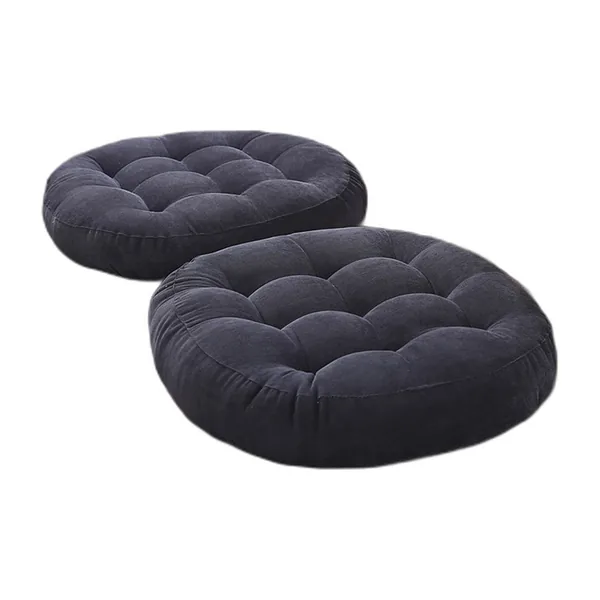 Round tufted floor cushion, 42 cm
A 42 cm tufted corduroy floor cushion: your hips lift, your knees drop and your back straightens on its own while you sit.
Round tufted floor cushion, 42 cm
A 42 cm tufted corduroy floor cushion: your hips lift, your knees drop and your back straightens on its own while you sit.
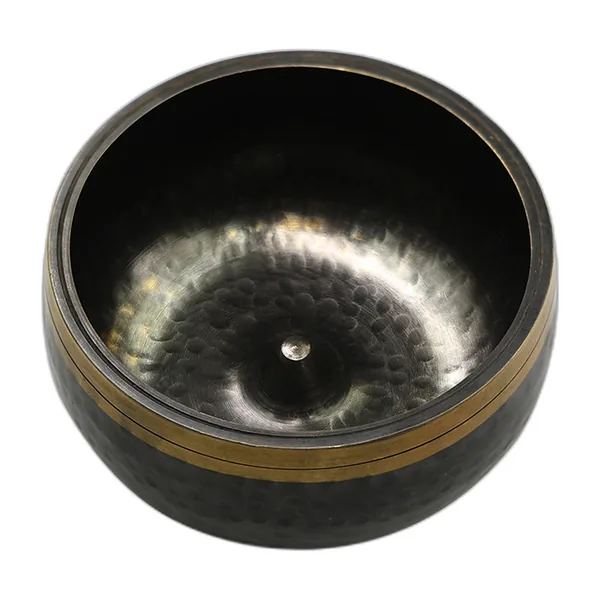 Hammered 12.5 cm sound bowl with mallet and cushion
A 12.5 cm, 635 g hammered bowl with mallet and cushion: a long, low resonance to follow into silence at the start of meditation.
Hammered 12.5 cm sound bowl with mallet and cushion
A 12.5 cm, 635 g hammered bowl with mallet and cushion: a long, low resonance to follow into silence at the start of meditation.
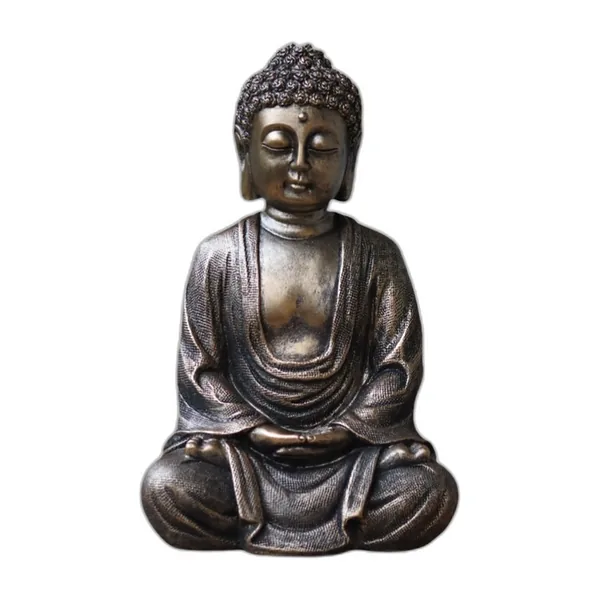 Meditating Buddha figurine, bronze-effect resin
A seated meditating Buddha in bronze-patina resin: a calm focal point that turns a corner of the room into a practice space.
Meditating Buddha figurine, bronze-effect resin
A seated meditating Buddha in bronze-patina resin: a calm focal point that turns a corner of the room into a practice space.
Free newsletter
One practical Ayurveda tip every Sunday
A seasonal habit, a recipe or a ritual taken from our articles, in a two-minute read. Your welcome gift: the 7-step Ayurvedic morning routine, unlocked right away. One-click unsubscribe.