Shiro Abhyanga: The Tension-Relieving Head Massage
Ten minutes of fingertips on your scalp, and the whole day unwinds. Head massage is the most immediate feel-good ritual in Ayurveda — provided you know the right pressure points and the right pace.
In this article 6 sections
Scalp massage — shiro abhyanga in Sanskrit — delivers quick, concrete benefits: immediate release of tension in the skull, neck and jaw, easier sleep onset, and a suppler scalp, which indirectly benefits the hair. It is one of the few Ayurvedic practices whose effect you feel the very first time, with no equipment, in 5 to 10 minutes. Tradition makes it a pillar of care for the head, seat of the sense organs; modern practice simply recognizes it as one of the most effective self-massages against accumulated nervous tension.
You can practice it with or without oil, preferably in the evening. Here are the precise strokes, in order.
What are the benefits of scalp massage?
- Nervous-system release: the scalp is covered with thin muscles that tighten under stress without your noticing. Massaging them relaxes the entire cranial band — many so-called "tension" headaches start there. To understand the different types of headaches, see our article on headaches and Ayurveda.
- Sleep: practiced slowly in the evening, it brings mental agitation right down. In the Ayurvedic reading, it directly pacifies Vata, the dosha of restlessness and light sleep.
- Hair and scalp: massage stimulates local microcirculation and loosens a tight scalp. Small studies suggest that prolonged daily massage might slightly thicken the hair shaft over the long term; the data remains preliminary — do not count on massage to treat genuine hair loss.
- Eyes and jaw: the temples and jaw attachments are part of the circuit; heavy screen users find notable relief there.
With or without oil: which should you choose?
Both are worthwhile, but they serve different purposes:
- Without oil: the everyday version. Doable anywhere, including at the office, on clean hair, in 3 to 5 minutes. This is the pure "tension-relief" format.
- With warm oil: the treatment version, once or twice a week, ideally before a shampoo. The oil adds scalp nourishment and the enveloping quality that is so soothing for Vata. It turns the massage into a complete hair oiling treatment if you continue down the lengths.
Which oil? As a general guide: sesame for most profiles and in the cold season, coconut for scalps that run hot (itching, Pitta tendency), and an oil infused with bhringaraj or brahmi if hair is the goal. The full breakdown by constitution is in our guide to massage oils by dosha. Always warm, never hot.
The strokes step by step: 10 minutes flat
- Neck and shoulders (1 min): start by kneading the base of the skull and the tops of the shoulders, where everything tightens up. Breathe slowly.
- Base of the skull (2 min): thumbs under the occipital bone, in the two hollows on either side of the spine. Slow, firm circular pressure. This is often the most sensitive spot — and the most rewarding.
- Entire scalp (3 min): fingers spread and laid flat as if shampooing, move the skin over the bone in small circles, without rubbing the hair. Work from the temples toward the crown, then from the nape toward the crown. Fingertip pads, never nails.
- Temples and jaw (2 min): slow circles on the temples, then on the jaw muscles (clench your teeth briefly to locate them, then release and massage).
- Crown of the head (1 min): tradition gives special attention to the vertex point; gentle, stationary pressure while breathing.
- Finish (1 min): comb the scalp with your fingers, very gently tug a few sections of hair by the handful to lift the skin, then rest your hands still for a few seconds.
The pace is everything: slow to calm down (evening), slightly brisker to wake up (morning). If you are massaging for sleep, slow down even more.
When and how often should you massage?
| Goal | Format | Frequency | Timing |
|---|---|---|---|
| Relaxation, sleep | No oil, 5 min, slow strokes | Daily | In the evening, as part of the evening routine |
| Scalp and hair care | Warm oil, 10 min + soak | Once or twice a week | Before shampooing |
| Quick calm-down | No oil, 2 to 3 min (temples, neck) | As needed | Screen break, end of day |
For entrenched sleep trouble, the traditional evening duo pairs head massage with foot massage — the complete approach is described in our protocol for better sleep with Ayurveda.
If your goal is hair thickness rather than relaxation, the only data point is a daily habit kept up for months: in a small study, nine healthy men used a massage device for 4 minutes a day for 24 weeks, and their average hair thickness rose from 0.085 to 0.092 mm (Koyama et al., Eplasty, 2016). There was no control group, the massage was mechanical rather than manual, and two authors worked for the device maker: an encouraging signal, not proof that occasional hand massage does the same. By dosha, tradition suggests frequent massage with sesame oil for Vata's dry scalp, two to three sessions a week with oil never hot for Pitta, and about twice a week with a light oil such as coconut for Kapha's oilier scalp. A scalp still greasy hours later means spacing sessions or using less oil; one that stays dry and tight calls for more frequent sessions or a richer oil.
Precautions and contraindications
- Damaged scalp: no massage over wounds, eczema or psoriasis flare-ups, folliculitis or a sunburned scalp. For any scalp condition, see a dermatologist first.
- Unusual headaches: a sudden, intense headache, or one accompanied by fever, visual disturbances or a stiff neck, is not a matter for massage but for urgent medical attention.
- Significant hair loss: gentle massage will not make it worse, but avoid tugging; above all, have the cause diagnosed by a doctor.
- Oil: warm, tested on the wrist; patch-test any new oil on the inner elbow, especially herb-infused oils or blends with essential oils (the latter: not for pregnant women or children without specialist advice).
- Pressure: the massage should feel good. Pain means too hard.
All of the site's safety rules are gathered in the safety and precautions guide.
Your questions about shiro abhyanga
Does scalp massage make hair grow?
It does not trigger regrowth and does not treat androgenetic hair loss. Some preliminary data suggests that a daily massage of several minutes, kept up for months, might slightly thicken the hair shaft by stimulating microcirculation. The effect is modest and slow: think of it as groundwork care, not a treatment.
How long should you massage your scalp?
Five minutes a day is enough for the relaxation effect; ten minutes with warm oil, once or twice a week, for the full treatment format. Five minutes every evening beats an occasional half-hour: it is the consistency that locks in the effects on tension and sleep.
Should you massage the scalp with or without oil?
Both work. Without oil: the daily tension-relief version, doable anywhere, on clean hair. With warm oil (sesame, coconut, or a bhringaraj-infused oil): the weekly treatment version, before shampooing, which nourishes the scalp on top of relaxing you. Ayurveda favors oil; the washing constraint often decides.
Does head massage really help you sleep?
Yes — it is its most reliable effect: slow strokes on the scalp, temples and base of the skull lower nervous tension and prepare you to fall asleep. Practiced every evening at the same time, it becomes a sleep cue for the brain. For entrenched insomnia, it complements — never replaces — medical advice.
Can you massage your scalp every day?
Yes, gentle daily massage is safe on a healthy scalp, and it is even the recommended rhythm for relaxation. Just avoid nails, vigorous rubbing and pulling on the hair, and pause during irritation, wounds or an eczema or psoriasis flare-up.
How often should you massage your scalp for thicker hair?
The only study available used a device for 4 minutes a day, every day, for 24 weeks, and found a small increase in hair thickness in nine men, without a control group. So if hair density is your goal, a short daily session kept up for months is the closest to what was tested, with no guaranteed result; for relaxation alone, two to three sessions a week are enough.
Our picks
Accessories chosen to go with this guide — prices in euros, VAT included, delivery in 8 to 15 business days, free from €39. Browse the whole shop.
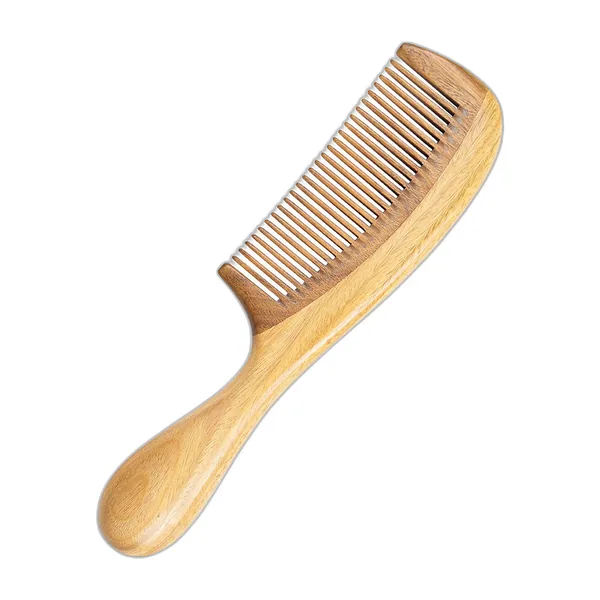 “Green sandalwood” wooden comb, fine teeth
A comb cut from one piece of hardwood sold as “green sandalwood”: it glides without snagging and finishes a scalp massage with a slow comb-through.
“Green sandalwood” wooden comb, fine teeth
A comb cut from one piece of hardwood sold as “green sandalwood”: it glides without snagging and finishes a scalp massage with a slow comb-through.
Free newsletter
One practical Ayurveda tip every Sunday
A seasonal habit, a recipe or a ritual taken from our articles, in a two-minute read. Your welcome gift: the 7-step Ayurvedic morning routine, unlocked right away. One-click unsubscribe.