Horn Comb: Why Ayurveda Prefers It Over Plastic
A simple comb, but not just any comb: natural horn is favored by Ayurvedic tradition for a very concrete reason — it barely charges hair with static electricity, unlike plastic.
In this article 7 sections
The horn comb, traditionally carved from buffalo or ox horn, is one of the hair accessories most recommended by Ayurvedic tradition — right after the copper tongue scraper in the hierarchy of "small objects with a big impact." Its reputation isn't rooted in mystical virtue but in a simple physical property: horn, a natural material, generates far less static electricity against hair than plastic does.
This point deserves detail, since it's the strongest argument for this choice — far more so than tradition alone.
Why does horn build up less static in hair?
Static electricity arises from friction between two materials that exchange electrons — a phenomenon called the triboelectric effect. Plastic, highly insulating, tends to accumulate this charge and transfer it to hair, causing frizz and hair that "clings" or lifts, especially in dry weather. Horn, an organic material close in composition to hair's own keratin, produces friction that's more electrically neutral. In practice, hair combed with horn stays smoother and less charged than with a lower-end plastic comb, especially in winter or dry climates.
It's worth being honest about the scope of this claim: an untreated metal or natural wood comb offers a comparable result on this specific point. Horn's advantage isn't exclusive, then, but it's real and documented by materials physics — unlike some other virtues sometimes attributed to horn without particular grounding.
Horn, wood or plastic: the comparison
| Criterion | Horn | Natural wood | Plastic |
|---|---|---|---|
| Static electricity | Very low | Low | High, especially in cold/dry conditions |
| Gentleness on the scalp | Smooth teeth, rounded with use | Varies with sanding | Varies, sometimes sharp edges |
| Lifespan | Years, with minimal upkeep | A few years, sensitive to humidity | Varies, can grow brittle over time |
| Typical price | $10 to $30 | $5 to $20 | $1 to $10 |
| Animal origin | Yes (a livestock byproduct) | No | No |
The horn comb naturally rounds out our Ayurveda starter kit, alongside the copper tongue scraper, for daily use that combines tradition with concrete practical benefit.
Does combing also help scalp circulation?
Beyond static electricity, regularly running a wide-toothed comb through hair mechanically stimulates the scalp, to a lesser degree but in the same spirit as scalp massage. A study by Koyama, Kobayashi, Hama, Murakami and Ogawa, published in 2016 in the journal Eplasty, showed in volunteers that standardized mechanical scalp stimulation exerted a stretching force on dermal papilla cells, associated with a measurable increase in hair thickness after several months of daily practice. This study looks at standardized manual massage, not combing itself: one can reasonably assume a similar, more modest effect, but no data measures it directly for a comb. For a stronger, better-documented effect, pair combing with regular massage, possibly with an oil like bhringaraj.
How to choose and care for a horn comb
- Wide teeth for detangling without breakage, finer teeth to smooth and distribute sebum through the lengths.
- Check the polish: run a finger over the teeth before buying — they should be perfectly smooth, with no rough spot that could snag hair.
- Care: wipe dry after use, avoid prolonged soaking in water, which can crack horn over time, and occasionally apply a drop of neutral oil to preserve its flexibility.
- Typical price: $10 to $30 depending on size and finish, for an object that lasts years with this minimal upkeep.
Precautions
Since horn is an animal-derived material, it doesn't suit people seeking strictly vegan products — natural wood is then a good alternative for limiting static electricity. If your scalp is irritated, has open wounds, or active psoriasis, favor gentle, spaced-out combing rather than vigorous strokes, and ask a dermatologist for advice if itching persists. For general guidance, see our safety and precautions guide.
How long it takes and how long to use it
How long before you notice an effect with a horn comb depends entirely on what you're looking at: the drop in static electricity is generally felt from the very first strokes, whereas the reduction in breakage and split ends takes several weeks to a few months of regular use.
Static electricity: a near-immediate effect
This is the fastest effect to notice. Unlike plastic, which easily builds up an electric charge through friction, horn is a material close to the keratin of hair and generates far less static on contact with the lengths. From the first or second use, especially in winter or in dry weather, the difference shows: less "flyaway" hair, fewer static frizz halos after combing.
Breakage and split ends: an effect that takes time
Here, patience is needed. A noticeable reduction in breakage or split ends generally takes several weeks to two or three months of daily or near-daily use. This longer timeline doesn't reflect a slow action of the horn on the hair fiber: it mainly reflects the time needed for lengths already damaged by aggressive plastic combing to grow out or recover gradually, while the new, gentler gesture limits the appearance of new breakage.
| Effect observed | Indicative timeline |
|---|---|
| Drop in static electricity | From the first strokes, a few days at most |
| Better glide, less catching on the scalp | Immediate to a few days |
| Less hair breakage | Several weeks to 2-3 months of regular use |
| More even distribution of sebum along the lengths | A few weeks of daily use |
What the available research says
No clinical study specifically covers the horn comb. A study by Koyama, Kobayashi, Hama, Murakami and Ogawa, published in 2016 in the journal Eplasty and already cited in horn comb reviews, looked at standardized mechanical stimulation of the scalp — a manual massage, not combing — and measured an increase in hair thickness in volunteers after several months of daily practice. We must be honest about the limits: this protocol doesn't concern the combing gesture as such, and its time scale (several months for a measurable effect on hair thickness) remains the only benchmark available in the literature, to be taken as an order of magnitude rather than direct proof about the horn comb.
Factors that influence the timeline
- Frequency of use: daily combing logically speeds up how quickly the effects are perceived compared with occasional use;
- Initial state of the lengths: hair already heavily damaged by prolonged use of plastic or heat will take longer to show a visible improvement;
- Hair type: fine or dry hair, more prone to static, often shows the difference fastest;
- Comb care: a well-maintained horn comb (never soaked, air-dried) keeps its antistatic properties longer than a neglected one.
Precautions
These timelines are indicative and vary from person to person. No comb, whatever its material, makes hair grow faster or treats pathological hair loss: in case of significant or unusual hair loss, see a dermatologist rather than waiting for a combing effect. The full usage precautions appear in our article on horn comb dangers and our safety and precautions guide.
Your questions about horn comb
Why does a horn comb prevent frizz?
Because it generates far less static electricity against hair than plastic, due to its composition being close to keratin. Natural wood offers a comparable result on this specific point.
Does a horn comb make hair grow faster?
No study demonstrates this for the comb itself. A 2016 study showed that mechanical scalp stimulation could increase hair thickness, but it looked at standardized manual massage, not combing.
How much does a good horn comb cost?
Expect $10 to $30 for a well-polished, durable comb, versus $1 to $10 for a low-end plastic comb that breaks and builds up more static.
How do you care for a horn comb?
Wipe it dry after use, avoid prolonged soaking in water, and occasionally apply a drop of neutral oil to preserve its flexibility. Well cared for, it lasts several years.
After how long do you feel less static with a horn comb?
This is the fastest effect: most users notice it from the very first strokes, especially in winter or in dry weather, when plastic usually makes hair "fly."
How long to see less hair breakage?
Allow several weeks to two or three months of regular use. This timeline mainly reflects the time needed for already-damaged lengths to recover, more than a fast action of the horn.
Does the horn comb work faster than a plastic comb?
On static, yes, almost instantly by the nature of the material. On breakage and overall hair health, the effect depends mainly on the regularity of the gesture, not specifically on the comb’s material.
Do you have to use it every day to see an effect?
Daily or near-daily use speeds up how quickly the effects are perceived, particularly on breakage and split ends. Occasional use stays beneficial but takes longer to be felt.
Our picks
Accessories chosen to go with this guide — prices in euros, VAT included, delivery in 8 to 15 business days, free from €39. Browse the whole shop.
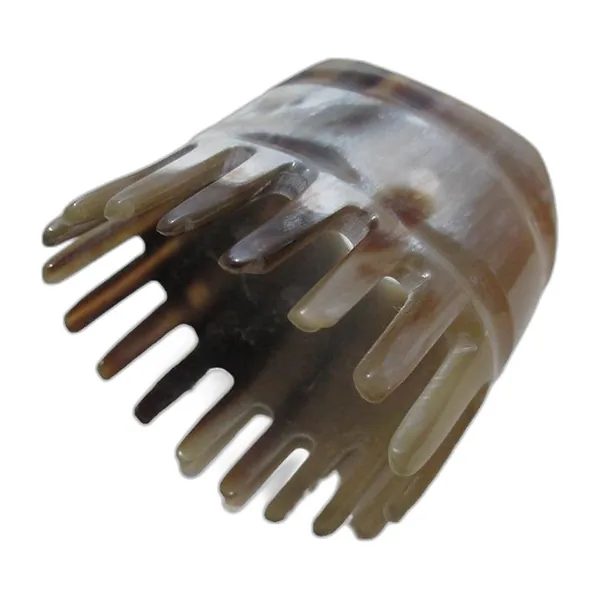 Wide-tooth buffalo horn massage comb
A compact buffalo horn comb with wide, rounded teeth: detangles thick hair without pulling and gives the scalp a gentle massage.
Wide-tooth buffalo horn massage comb
A compact buffalo horn comb with wide, rounded teeth: detangles thick hair without pulling and gives the scalp a gentle massage.
Free newsletter
One practical Ayurveda tip every Sunday
A seasonal habit, a recipe or a ritual taken from our articles, in a two-minute read. Your welcome gift: the 7-step Ayurvedic morning routine, unlocked right away. One-click unsubscribe.